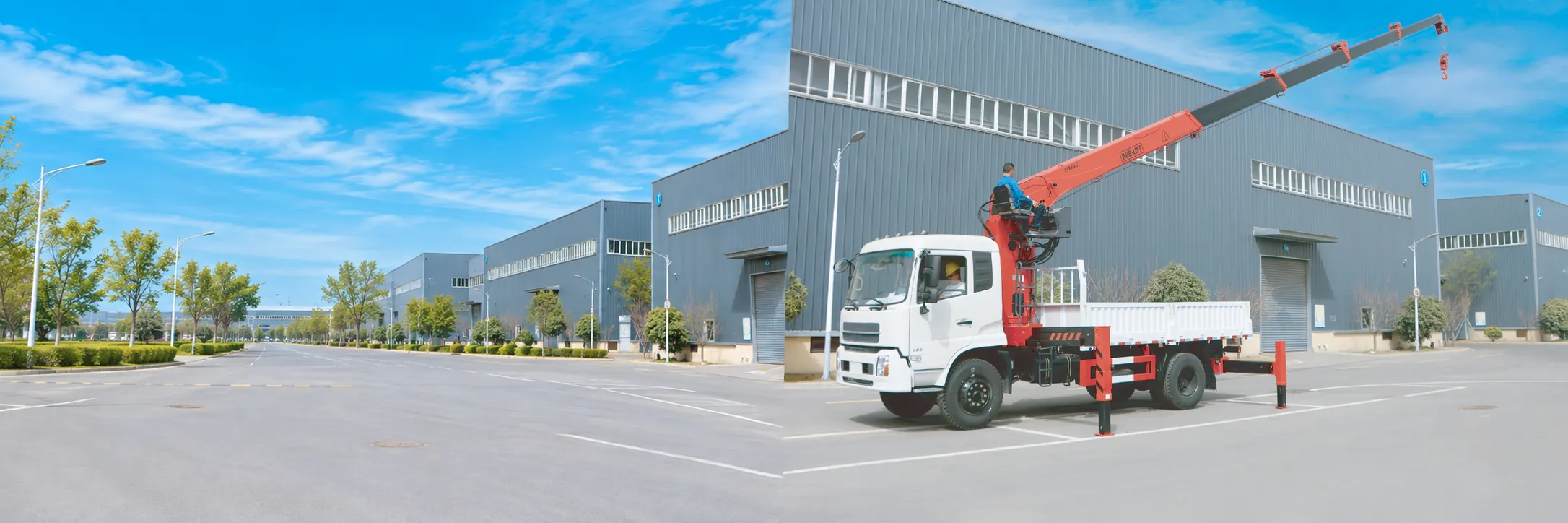

A truck mounted crane is a hydraulic crane fixed to the chassis of a cargo truck, usually just behind the cab. Because the truck carries the goods and the crane loads and unloads them, a single vehicle and a single operator can handle both the delivery and the lifting. It is also known as a crane truck, a lorry mounted crane, a loader crane, a boom truck or simply a crane on a truck. The crane operates on hydraulic oil supplied by a pump that the truck’s engine drives, stands on its own outriggers while it lifts, and folds or retracts into a compact position for travelling on public roads.
BOB-LIFT has built truck mounted cranes in Xuzhou, China, since 2003, from 800 kg pickup cranes up to 50 t knuckle boom cranes. This guide explains what a truck mounted crane is, how the hydraulic system operates and which main components it has. It also describes the available types, the typical applications and the different names, replacing our older and much shorter article on the same subject.
Key takeaways
- A truck mounted crane is a hydraulic crane installed on a cargo truck, so the same vehicle transports the load and lifts it.
- The truck’s power take-off drives a hydraulic pump, and the pressurised oil operates the cylinders and motors that raise, extend and slew the boom.
- The two main types are the knuckle boom, which folds like an arm, and the telescopic boom, which extends in a straight line, while small cranes for pickups form a third group.
- Lifting capacity falls as the boom reaches further out: our 12 t telescopic SQ12SA4 lifts 12,000 kg at 2.5 m but only 1,200 kg at 16.19 m.
- In many markets “truck crane” means a mobile crane on its own dedicated carrier, which is an entirely different machine.
What is a truck mounted crane?
A truck mounted crane is a crane mounted on a truck that still operates as an ordinary delivery vehicle. The crane sits on a base bolted to the chassis frame, while the remaining length of the frame keeps its cargo body. On arrival the operator sets the outriggers, lifts the load off the deck and places it exactly where it is needed, usually without a forklift or any additional machine on site.
International standards use the name loader crane, and the European standard EN 12999 “Cranes – Loader cranes” covers hydraulic powered loader cranes and their mountings on vehicles or static foundations. It describes a loader crane as a power-driven crane with a column that slews about a base and a boom system, designed for loading and unloading vehicles. In the United States, the crane rules for construction in 29 CFR 1926.1400 list “commercial truck-mounted, and boom truck cranes” among the equipment they cover.
A crane mounted vehicle of this kind therefore performs two separate functions, working as a delivery truck on the road and as a lifting machine at the destination. That combination is the main reason transport fleets, builders’ merchants and equipment service companies invest in one.
What other names does a truck mounted crane have?
The same machine goes by many different names, and buyers in different countries describe it differently. Each of the following terms means a hydraulic crane installed on a cargo truck:
- Crane truck. The most common everyday name, describing the complete vehicle together with its crane.
- Lorry mounted crane or lorry loader. The usual British terms; the UK safety regulator, the Health and Safety Executive, calls these machines lorry loaders.
- Loader crane. The technical name used in the EN 12999 standard and by many manufacturers.
- Boom truck. Usually describes a commercial vehicle equipped with a telescopic boom crane.
- Crane on truck, crane mounted on truck or crane in truck. Plain descriptions that people often type into a search engine, all pointing to the same machine.
- Camion grue. The French name for a crane truck.
One name requires particular care, namely truck crane, because in many markets it describes a completely different machine, as explained further below.
How does a truck mounted crane work?
A truck mounted crane operates hydraulically: the truck’s engine provides the energy, pressurised hydraulic oil transmits it to the crane, and hydraulic cylinders and motors convert it into controlled movement. Every lifting operation follows the same sequence.
- Power take-off and pump. With the vehicle parked, the operator engages the power take-off (PTO) on the gearbox, which drives a hydraulic pump that delivers oil from the crane’s tank to the control valve. Every crane requires a specific flow and pressure; our SQ12SA4, for example, requires 75 L/min at 26 MPa and a recommended 45 kW. Some small cranes use an electric motor and pump instead of a PTO.
- Outriggers. Before lifting, the operator extends the outrigger beams and lowers the legs to the ground, which relieves the vehicle’s suspension and tyres and widens the supporting base so the truck remains stable. In Britain they are usually called stabilisers.
- Control valve. The operator moves levers on the crane base, or the joysticks of a radio remote control, to open individual sections of the valve, each of which supplies one crane function.
- Slewing. A hydraulic slewing mechanism rotates the column, allowing the boom to swing from the cargo deck to either side of the vehicle; our SQ12SA4 and SQ10ZA4 slew 360°, while the compact SQ08ZA3+1 pickup crane slews 330°.
- Boom movement. Cylinders raise and lower the boom, and extension cylinders push out the boom sections to add reach.
- Hook or winch. The load hangs either from a hook on the boom tip or from a wire rope on a hydraulic winch. Many cranes can also operate optional attachments such as a grab, a hydraulic gripper or an auger.
The most important principle for every crane is that lifting capacity decreases as the load moves further away from the column, because the rated tonnage only applies at a short working radius. Our 12 t telescopic SQ12SA4, for example, lifts 12,000 kg at 2.5 m, 5,800 kg at 5.54 m and only 1,200 kg at its maximum 16.19 m radius. A crane should therefore always be selected by the load at your actual working radius, not by the capacity figure in its name. Our guide on how to read a crane load chart shows how to check it.
Our model designations also describe the boom construction. In SQ12SA4, “SQ” stands for truck mounted crane, “12” is the 12 t class, “S” means a telescopic boom and “A4” means one main boom plus three hydraulic sections. A “Z” in the same place, as in SQ10ZA4, means a knuckle boom.
What are the main parts of a truck mounted crane?
Most truck mounted cranes share the same principal components, regardless of their capacity:
- Base and outrigger box. The structural frame that is bolted to the vehicle’s subframe and houses the extending outrigger beams.
- Outriggers. Extending beams and hydraulic vertical legs that stabilise the vehicle during lifting operations.
- Slewing mechanism and column. The vertical column stands on the base and rotates on the hydraulic slewing drive.
- Booms and cylinders. The main boom, plus a folding outer boom on a knuckle crane, and the telescopic sections that extend.
- Hydraulic system. Power take-off, pump, oil tank, control valve, hoses and filters.
- Controls and safety devices. Control levers, an optional elevated seat or radio remote control, and devices that protect against overloading.
- Hook, winch and attachments. The equipment that holds and manipulates the load.
Our article on truck mounted crane parts identifies every component on a technical drawing and recommends which spare parts to keep in stock.
What types of truck mounted crane are there?
Truck mounted cranes are classified mainly by the design of the boom, and secondarily by capacity and by the position of the crane on the vehicle.
Knuckle boom cranes
A knuckle boom crane folds like a human arm. American regulations call it an articulating crane, defined in 29 CFR 1926.1401 as a crane whose boom is “a series of folding, pin connected structural members”, usually moved by hydraulic cylinders. When stowed it folds into a compact package behind the cab, leaving more of the cargo deck available, and it can reach over a wall and down behind it while operating grabs and other hydraulic attachments effectively. We build knuckle boom truck cranes from 1.6 t to 50 t.
Telescopic (straight boom) cranes
A telescopic crane has a straight boom made of sections that slide out of each other, providing long, direct reach and considerable hook height. It usually lifts with a hydraulic winch and wire rope. Many buyers call it a straight boom crane or a boom truck. Our telescopic boom truck cranes run from 2 t to 20 t.

Pickup and small truck cranes
The smallest cranes are designed for the cargo bed of a pickup or a light commercial vehicle. Our SQ08ZA3+1 is an 800 kg class pickup crane with a self weight of 380 kg. It lifts 800 kg at 1.34 m and 220 kg at its maximum 4.15 m radius, and its two outrigger legs adjust from 1,464 to 3,020 mm in span. It is typically used for generators, pumps, gas cylinders and tool boxes in maintenance, agricultural and utility operations.
Behind the cab or at the rear?
Most cranes are installed directly behind the cab, where the boom can reach over the entire cargo body, although the crane’s weight is then carried mainly by the front axle. A rear installation transfers the weight to the rear axle and suits operations where the crane works off the back of the vehicle, but it can leave the steering axle too lightly loaded when the truck travels empty. Our truck mounted crane installation guide shows how to check both cases.
Knuckle boom vs telescopic vs pickup crane: how do they compare?
This table compares three of our cranes, one representative model of each type, using figures taken directly from their technical drawings and load charts.
| Point | Knuckle boom SQ10ZA4 | Telescopic SQ12SA4 | Pickup crane SQ08ZA3+1 |
|---|---|---|---|
| Capacity class | 10,000 kg at 2 m | 12,000 kg at 2.5 m | 800 kg at 1.34 m |
| Load at full reach | 1,880 kg at 10.495 m | 1,200 kg at 16.19 m | 220 kg at 4.15 m |
| Lifting moment | 21 t·m | 33 t·m | 1.3 t·m |
| Crane self weight | 3,350 kg | 4,600 kg | 380 kg |
| Hydraulic supply | 40 L/min at 30 MPa, 30 kW | 75 L/min at 26 MPa, 45 kW | 8 L/min at 18 MPa, 3.5 kW |
| Slewing | 360° | 360° | 330° |
| Outrigger span | 2,310–5,610 mm | 2,300–7,500 mm | 1,464–3,020 mm |
| Best at | Compact stowage, reaching over obstacles, hydraulic attachments | Long, straight reach and considerable hook height | Light equipment from a pickup bed |
Notice that the telescopic crane reaches further, while the knuckle boom crane lifts more at the end of its shorter reach and weighs less. Neither configuration is better for every application, so the right choice depends on the working radius you need and the amount of deck space you want to keep available for cargo.
What jobs does a truck mounted crane do?
A truck mounted crane is valuable wherever materials arrive by road and need to be lifted at the delivery location. Typical applications include:
- Building materials. Concrete blocks, bricks, palletised materials, reinforcing steel, timber and precast components delivered to construction sites and builders’ yards.
- Machinery and equipment. Generators, compressors, containers and compact machines transported between locations.
- Utilities and maintenance. Poles, pipes, transformers and pumps for electricity, water and telecommunications crews.
- Agriculture and forestry. Animal feed, fertiliser, timber and agricultural equipment.
- Urban and port operations. Lifting in narrow streets, warehouses and docks where a larger mobile crane cannot easily set up.
The applicable regulations can depend on the activity. For example, American construction regulations exclude knuckle boom truck cranes that only deliver material to a site and set it on the ground, without arranging it for hoisting, under paragraph (c)(17) of 29 CFR 1926.1400. Other lifting operations on the same site may still be covered, so confirm which requirements apply to your particular work.
Whatever the application, ground conditions are critical. 29 CFR 1926.1402 says the equipment must not be used unless the ground is firm, drained and graded enough to meet the maker’s support and level requirements. Outriggers also require attention when they are retracted and stowed. HSE’s safety notice on lorry loaders reports three fatal incidents in Great Britain since 2019 in which an operator was crushed by a retracting powered tilting stabiliser.
Is a truck crane the same as a truck mounted crane?
Not always. In many markets, “truck crane” means a mobile crane built on its own dedicated carrier, a machine that lifts heavier loads and reaches higher but carries no cargo, so the materials arrive on a separate vehicle. A truck mounted crane, by contrast, is installed on a cargo truck and transports what it lifts, although in some regions people use “truck crane” loosely for both machines.
If you need to deliver materials and unload them independently, a truck mounted crane is the appropriate machine. For an occasional heavy lift with no cargo to transport, a mobile crane may be more suitable. Our full truck mounted crane vs mobile crane comparison explains the differences in detail.
How do you choose a truck mounted crane?
Five practical questions narrow the selection quickly:
- What is your heaviest regular load, and at what distance from the truck? Read the manufacturer’s load chart at that working radius and keep a reasonable safety margin.
- Do you need compact folding or long, straight reach? The answer usually determines whether a knuckle boom or a telescopic boom is the better configuration.
- Which truck will carry it? The crane’s own weight reduces the vehicle’s available payload, and the axle ratings, the free frame length behind the cab and the power take-off must all be compatible with the crane.
- Which controls and attachments do you need? Decide between manual levers, an elevated operator seat or a radio remote control, and between a hook, a winch, a grab or an auger.
- Who will install it? If you buy a Chinese truck, your truck supplier can deliver it to our factory and we mount the crane there. If you buy the truck at home, plan the installation, inspection and vehicle registration with a qualified body builder in your country.
BOB-LIFT manufactures and exports the crane only. If you buy a Chinese truck, your truck supplier can deliver it to our factory and we mount the crane before it ships. If you buy the truck in your own country, your local body builder installs the crane and our engineers give remote technical support. Send us the chassis model, wheelbase, axle ratings and PTO details, and we confirm which crane fits before you order. Our guide to buying a truck mounted crane from China covers the quotation, testing and shipping steps.
Example scenario (an illustration, not a customer record): a builders’ merchant regularly delivers palletised concrete blocks weighing up to 1,500 kg and frequently positions them about 8 m from the vehicle, over a garden wall. The SQ12SA4 load chart shows 2,740 kg at 9.09 m, so the telescopic crane still has a comfortable margin at 8 m. A knuckle boom crane of similar capacity could also be suitable and would fold away to preserve deck space. The merchant therefore requests both load charts and compares them at 8 m before deciding.
Frequently asked questions
What is a truck mounted crane used for?
It loads and unloads the vehicle it is installed on and lifts materials at the delivery location. Common loads include building materials, machinery, pipes, poles and equipment for construction, utilities, agriculture and maintenance operations.
Is a crane truck the same as a truck mounted crane?
Yes. Crane truck, truck mounted crane, lorry mounted crane and loader crane all describe a hydraulic crane fitted to a cargo truck. Boom truck usually means the telescopic type. Truck crane is the exception, because in many markets it means a mobile crane on its own carrier.
How much can a truck mounted crane lift?
It depends on the individual crane and on the working radius. Our range extends from 800 kg pickup cranes to 50 t knuckle boom cranes, but every crane lifts considerably less as the boom extends. The 12 t SQ12SA4 lifts 12,000 kg at 2.5 m and 1,200 kg at 16.19 m, so always consult the load chart at your actual radius.
How is a truck mounted crane powered?
Most are powered by the truck’s engine through a power take-off that drives a hydraulic pump, which must deliver the crane’s rated oil flow at its specified working pressure. Some small cranes for pickups use an electric motor and pump instead.
Does BOB-LIFT supply the truck as well?
No. We manufacture and export new cranes only. If you buy a Chinese truck, your truck supplier can deliver it to our factory and we mount the crane for you. If you buy the truck locally, your body builder installs the crane with installation guidance and remote technical support from our engineers. We verify compatibility from your chassis information before you order.
Which is better, a knuckle boom or a telescopic crane?
Neither is better for every application. A knuckle boom folds compactly, preserves more deck space and reaches over obstacles, whereas a telescopic boom provides long, straight reach and greater hook height, so compare the load charts of both at your working radius.
How we compiled this guide
We rewrote our 2022 article on truck cranes and truck mounted cranes in November 2026. The specifications come from the technical drawings and load charts of the SQ10ZA4, SQ12SA4 and SQ08ZA3+1, and from their product pages. The regulations and standards are summarised from the official texts linked above, as they stood in November 2026. The photographs and video show genuine cranes in our Xuzhou factory. The guide was reviewed by Achord Chan, Product Operations Director. It does not replace the operating manual or the regulations that apply where you work.
Find the right truck mounted crane
Browse our complete range of truck mounted cranes, from 800 kg pickup cranes to 50 t knuckle boom cranes, each with its technical drawing and load chart. We export to more than 120 countries, usually from Lianyungang, Qingdao or Shanghai. Every crane carries a 12-month warranty on the entire machine, common spare parts are dispatched within 48 hours and our service team replies within 12 hours. Tell us your heaviest load, your working radius and your vehicle specification, and contact us for a quotation.